Productivity
How to get 3x more done in your business: Elon Musk's 5-step algorithm, the 80/20 rule and Hormozi's value equation
Your business doesn't eat your day. Work that doesn't sell does. Use Musk's 5 steps, the 80/20 rule on your sales sheet and Hormozi's value equation to fix it.
9 min read

On this page
Your business doesn't take up your whole day because there's too much work. It takes up your whole day because most of the day goes to things that don't sell.
The numbers are brutal. Salesforce's State of Sales report, a survey of about 5,500 sales professionals in 27 countries, found that reps spend 70% of their time on non-selling tasks. Asana's 2023 Anatomy of Work index found that 58% of the workday goes to "work about work": hunting for information, chasing answers, sitting in meetings that didn't need to happen. And a Time Etc survey of owners running growing businesses found that 36% of their week goes to admin: roughly 16 hours of a 45.5-hour week.
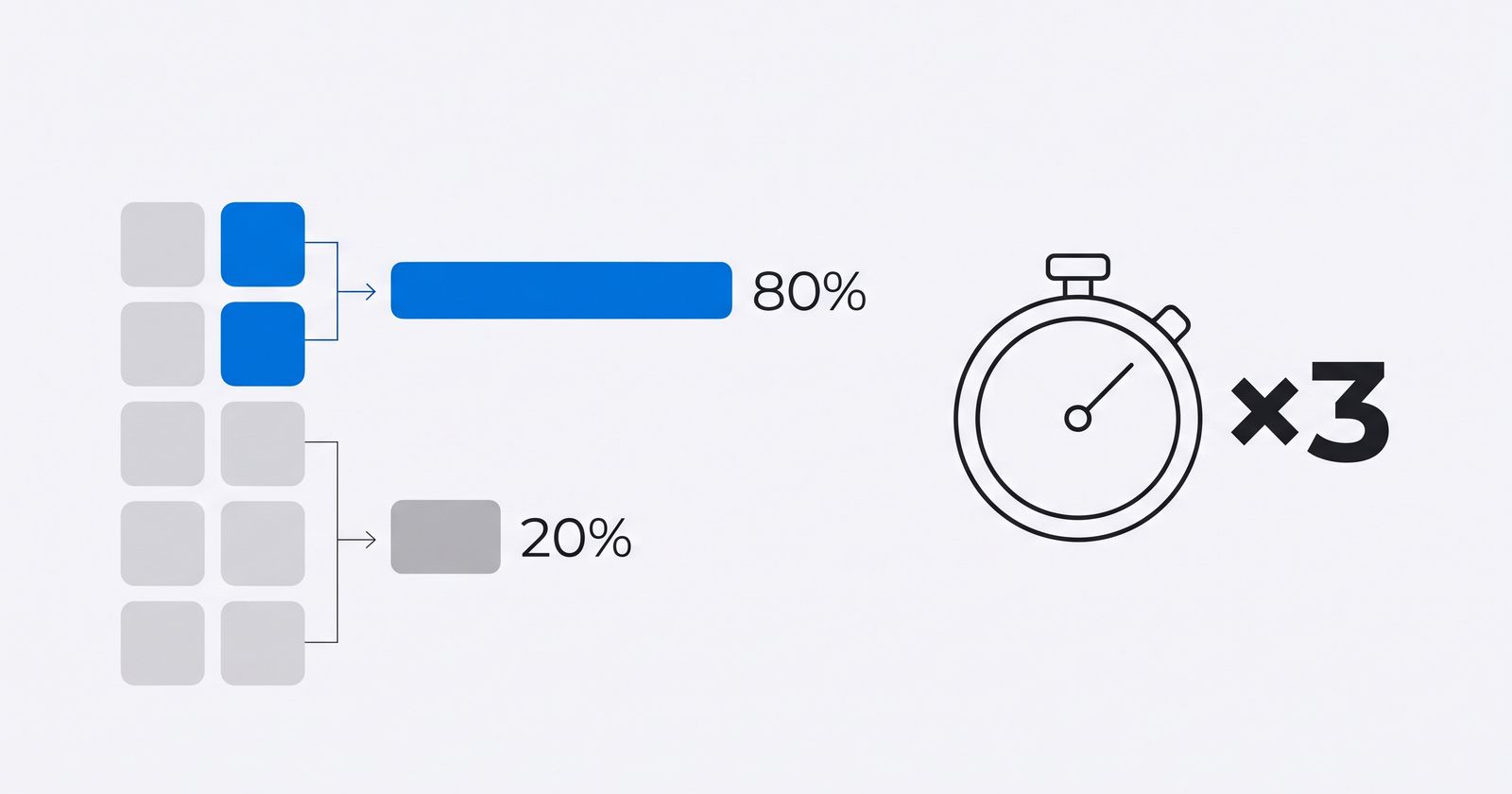
Run the numbers. If only 30% to 42% of your time actually produces something, pushing that toward 100% multiplies your output by 2.4 to 3.3. Getting 3x more done isn't a motivational line. It's arithmetic. (The math is ours, based on those figures.)
Here are three tools to get there, in the order you should use them.
1. Elon Musk's 5-step algorithm

Search "Elon Musk algorithm" and you may land on X's recommendation algorithm. This isn't that. It's the five-step method Musk repeats in his factories, the one Walter Isaacson calls "the algorithm" in his 2023 biography (Fortune). Musk also walked through it in 2021, on a tour of SpaceX's Starbase site in Texas with science communicator Tim Dodd (Everyday Astronaut).
The order matters more than the steps themselves:
- Question every requirement. Every rule should come with the name of the person who made it. Not "that's how we do it," not "accounting asked for it." And you question it even when it comes from someone very smart.
- Delete any part or process you can. In the book's version, if you don't end up adding back at least 10% of what you deleted, you didn't delete enough.
- Simplify and optimize. But only after you delete. In the 2021 interview, Musk says the most common error of a smart engineer is "to optimize something that should not exist."
- Accelerate cycle time. Everything can go faster, but only after the first three steps.
- Automate. Last. If you automate a process that shouldn't exist, you just do the wrong thing faster.
What it looks like in a small business
Picture a bakery that takes cake orders over WhatsApp (or Instagram DMs, or text). Its process has nine steps: reply, send the menu as a PDF, ask the flavor, ask the size, ask the date, work out the delivery fee, send payment details, wait for the payment receipt and write the order in a notebook.
- Question: who decided the menu goes out as a PDF? Nobody. Someone did it that way once. Customers open it on their phone and don't read it.
- Delete: the PDF goes. The three questions (flavor, size, date) become a single question with options, sent with the greeting.
- Simplify: the delivery fee, which used to be figured out neighborhood by neighborhood, becomes a table with flat rates. The notebook becomes a spreadsheet.
- Accelerate: WhatsApp Business quick replies keep the greeting with its options and the payment details written and ready to send.
- Automate: what's left now happens the same way every time, and that's when it's worth handing it off to someone else.
From nine steps to five, before spending a dime on automation.
2. The 80/20 rule: find the 20% that pays the bills
The 80/20 rule says a few customers, products or tasks produce most of the results. It's called the "Pareto principle" after Vilfredo Pareto, an Italian economist who studied how unevenly wealth was distributed in the late 1800s. The story everyone repeats is that 20% of the people owned 80% of the land in Italy.
But Pareto didn't come up with the rule. Joseph Juran, a quality-management expert, turned it into a general principle in the late 1940s, while writing his Quality Control Handbook. In 1974 he published a short piece called "The Non-Pareto Principle; Mea Culpa," confessing that he had "mistakenly applied the wrong name to the principle". Pareto had only studied wealth. The general idea of "the vital few and the trivial many" was Juran's. He later swapped "trivial" for "useful."
What the research says: it's closer to 70/20 than 80/20
When researchers measure it with real data, the split is rarely exact:
| Study | What it measured | The top 20% of customers bring in… |
|---|---|---|
| Kim, Singh and Winer (2017) | 6 years of purchases from more than 100,000 households (consumer packaged goods) | 73% of a brand's sales |
| McCarthy and Winer (2019) | 339 public companies | 67% of sales (68% without subscriptions, 59% with subscriptions) |
| Ehrenberg-Bass Institute | Brand buyers | About 60% |
So don't expect a perfect 80/20. But in almost any business, a small group of customers and products carries most of the load. And McCarthy and Winer's early results show that profits are even more concentrated than sales.
How to find your own 80/20 in a spreadsheet
- Export your sales from the last 12 months, by customer (or by product).
- Sort them from highest to lowest.
- Add a column with the running percentage. If sales are in column B, starting in row 2, put this in C2 and drag it down:
=SUM($B$2:B2)/SUM($B$2:$B$N). Replace N with your last row (201 if you have 200 customers). - Check the running percentage where your top 20% ends (row 41 if you have 200 customers). That's your number.
- Do it again with profit, not just sales. Sometimes the customer who buys the most is the one who leaves you the least.
What to do with the result
- Protect that 20%: answer them first, call them by name, tell them about anything new before anyone else.
- Copy that 20%: what do they have in common? Did they come in through the same channel? Put your ad budget there.
- Cut what doesn't pay: the products nobody orders that tie up inventory, the customers who haggle over everything and want special invoicing.
If your customers reach you on WhatsApp, our guide to selling on WhatsApp shows how to use labels to set that 20% apart from the very first chat.
3. Hormozi's value equation: sell more without working more
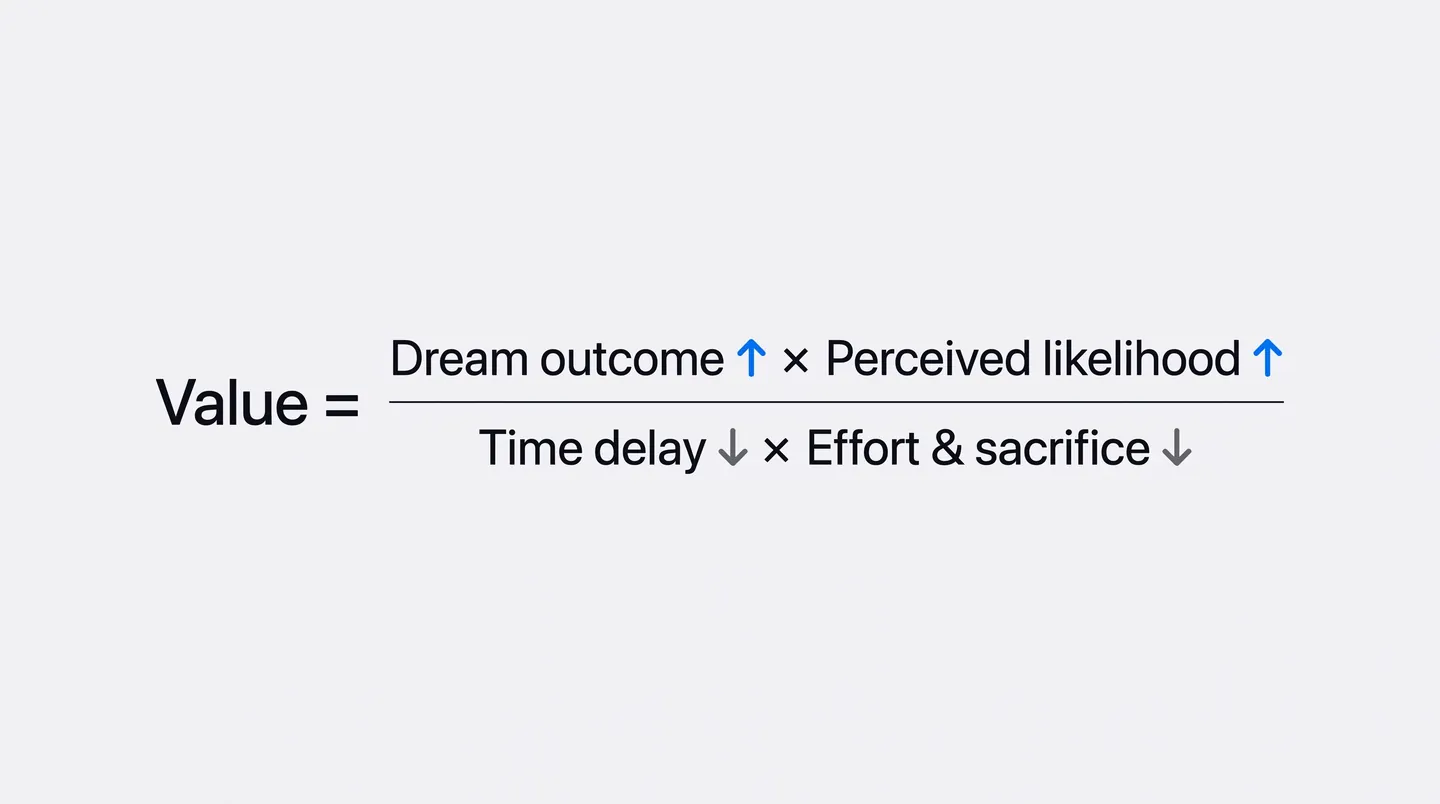
Musk and Pareto help you spend less time. Alex Hormozi helps the same time sell more. In his book $100M Offers (2021), he argues that the value a customer sees in what you sell comes down to four things (book summary):
Value = (Dream Outcome × Perceived Likelihood of Achievement) ÷ (Time Delay × Effort & Sacrifice)
There are two ways to raise value: make the top bigger or make the bottom smaller. His company's official worksheet boils it down to four levers (Acquisition.com):
| Lever | What it means | Example: a nutritionist |
|---|---|---|
| ↑ Dream Outcome | Solve a problem worth solving | Not "a meal plan," but "walk down the aisle in the dress you already bought" |
| ↑ Perceived Likelihood of Achievement | Show that it works | Before-and-after photos (with permission) and how many clients got there |
| ↓ Time Delay | Make results show up soon | A first visible change in two weeks, measured together |
| ↓ Effort & Sacrifice | Make it easy | A ready-made grocery list and 15-minute recipes, not a 40-page PDF |
The uncomfortable part: on that same worksheet, Hormozi tells you to "be more expensive than everyone else (by enough that it causes consumer to pause)," and to justify the price with value instead of lowering it.
The five ingredients of an irresistible offer
Hormozi calls an offer so good it can't be compared to anything else on the market a Grand Slam Offer. Based on the free worksheets he publishes at Acquisition.com:
- Scarcity: a real limit. "I only take 10 new clients a month."
- Urgency: a date. "The January group starts on the 15th."
- Bonuses instead of discounts: don't cut the price; add something useful (a guide, an extra call) and put a price tag on each bonus.
- A guarantee: for example, "if you don't see the first change in two weeks, we keep going at no cost until you do."
- A name that says the result: not "Nutrition Plan," but "8-Week Wedding Dress Challenge."
How the three fit together: a one-week plan
| Day | What you do | Tool |
|---|---|---|
| Monday | Export your sales and find your 80/20 by customer and by product | Pareto |
| Tuesday | Write down every step of your week and put a name on every rule | Musk, step 1 |
| Wednesday | Delete whatever nobody defended and simplify what's left | Musk, steps 2 and 3 |
| Thursday | Redesign your offer for the 20% who buy the most, using the four levers | Hormozi |
| Friday | Speed up what repeats with templates and decide what to automate | Musk, steps 4 and 5 |
Automation comes last (and that's when it pays off)
Musk's step 5 is the one everyone wants to do first, and it's the one that wastes the most when it's done too early. But once you've questioned, deleted and simplified, what's left is usually work that repeats the same way every day: answering the same questions, following up, sending Monday's sales summary.
That's the work AI agents do best: with your rules, on your channels, handing anything out of the ordinary to a person. With Ageentiq, you start from your goal and see it as a map of steps; the agents take care of the repetitive part. If you want to see which tools to use before you get there, read AI tools for small business: ChatGPT, Canva, Meta Ads and CapCut.
Frequently asked questions
What is Elon Musk's 5-step algorithm?
It's his method for improving any process, in this order: question every requirement, delete any part or process you can, simplify and optimize, accelerate cycle time, and automate. Walter Isaacson calls it "the algorithm" in his 2023 biography. It has nothing to do with X's recommendation algorithm.
Why is automation the last step?
Because if you automate a process that shouldn't exist, you only make it faster and more expensive to change. Delete and simplify first; automate what's left.
What is the 80/20 rule in sales?
The idea that a minority of customers or products produces most of your sales. Studies with real data find splits like 60/20 or 73/20 rather than an exact 80/20, but the concentration is almost always there.
Who came up with the 80/20 rule?
Joseph Juran, a quality-management expert, stated it as a general rule in the late 1940s and named it after Vilfredo Pareto, who had only studied the distribution of wealth. In 1974 Juran admitted the name was a mistake.
How do I apply the 80/20 rule to a small business?
Sort 12 months of sales by customer and by product, add a running percentage and see how much the top 20% adds up to. Then look after those customers first, find more like them and cut what doesn't pay.
What is Alex Hormozi's value equation?
Value = (Dream Outcome × Perceived Likelihood of Achievement) ÷ (Time Delay × Effort & Sacrifice). It comes from his book $100M Offers. To make your offer worth more, grow the top or shrink the bottom.
What is a Grand Slam Offer?
Hormozi's name for an offer so good it can't be compared to anything else on the market. It stacks scarcity, urgency, bonuses instead of discounts, a guarantee and a name that says the result.
Get new posts by email
One email when we publish: ideas to sell more, get more done and use AI in your business, with sources. Unsubscribe in one click.
By subscribing you accept our privacy policy.